



Talent management and Hybrid Work: New challenges and HR management
The employment world has undergone huge transformations after the spread of the pandemic. One of the areas that has had to face most challenges is Human Resources. The imposition of hybrid work, new recruitment methods and the need for a new working culture have required a complete rethink of this department and, as a result, it is now more crucial than ever before to understand the challenges that today’s HR Directors have to tackle.
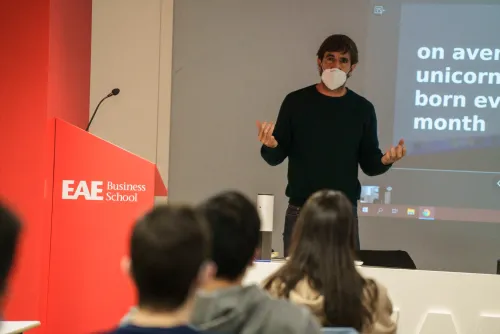
To this end, the specialist and Director of HR and Talent Programs at EAE Business School, Javier L. Crespo, recently ran an interesting online conference online, entitled ‘Challenges of HR Management, Talent Management and Hybrid Work’, which analysed the key points on this topic.
Ready to learn all about hybrid work and the new challenges for HR? Let’s find out more!
Update on Hybrid Work: best practices for organizing HW
Hybrid Work (HW) is the format in which an employee works for a certain part of their timetable from home and another part in the office. According to Crespo, there are a number of key factors for organizing Hybrid Work effectively, including flexibility, the workspace and timing.
“The working culture in Spain is heavily office-based”, explained Crespo. However, this will become less and less common because it has now been shown that flexibilization offers a lot of benefits”.
He went on to say that it is often the fault of the managers that this office-based culture persists. However, working from home and the experience of the last few months has made it clear that flexibilization can even result in greater output.
The work/life balance is becoming an increasingly important issue, as it is fundamental for achieving employee satisfaction. “A flexible job that enables autonomy and managing your own time enables employees to organize themselves better and leave space for other matters, such as family”, explained Crespo.
Guidelines for productivity in Hybrid Work
So, how can we guarantee that hybrid work is really effective? Crespo highlighted the following guidelines:
Ensure that your workspace and timetable motivate productivity.
People are more productive when they have positive vitality and wellbeing and their productivity drops when they are exhausted, so we have to embrace healthy work habits.
When people can align with each other fluidly, they can aim towards the same goals and be efficient. We have to create collaborative teams and ecosystems.
Systems: Two/three or three/two – It has been shown that strategies of working 2 or 3 days a week at the office are optimal.
Asynchronous timetables: It is important to let employees disconnect to reset to their natural energy rhythm.
E-leadership: The role of leadership in people management
As is to be expected, leadership is another essential part of the new talent management and, while great progress has already been made, there is still some way to go in terms of adapting to the new reality.
“Group cohesion has become vital, particularly with the rise in remote working”, emphasized Crespo. “The better the group interrelates, the more cohesive it will be and this ultimately results in greater output”.
Setting targets right from the start and planning and coordinating the team’s tasks with the team itself are other key aspects that leadership has to take into account nowadays in order to motivate the team and drive it forward. Last but not least, Crespo focused on empowerment, “Empowering employees and placing trust in them will help them perform better and get more involved” he added.
Hybrid talent management: Lessons and revising talent policies
What aspects of this model do we have to think about and rethink? Crespo recommended having and developing certain policies:
Employer branding: this is crucial for offering employees a value proposition that fosters loyalty while also encouraging them.
The manager and team play a key role in the welcome process.
Social activities for learning the role and organizational aspects.
Lifelong learning.
“In HR management, not only are we building a new department, but also constructing new organizations. Therefore, the new management must be talent-oriented and focused on the new working culture”, concluded Crespo.